Bulk Material Transport Rail System

Challenge
The project involved analyzing transport operations of a single-track railway corridor used for bulk material transportation. The railway operates with a centralized control system and includes multiple passing loops for trains traveling in opposite directions.
Each train consists of a set number of wagons carrying thousands of tons of material. The corridor handled several loaded trains per day, with a full cycle time of over two days. The objective was to assess the railway's capacity to accommodate additional trains while ensuring smooth operations and avoiding collisions.
The main challenge was increasing throughput while maintaining safe and efficient train movements on a single-track system with delays at passing loops and limited data on existing control mechanisms.
Solution
A simulation model was developed using AnyLogic's Rail Library and Process Modeling Library.
Railway Layout & Track Infrastructure
The available information regarding rail layout was only geolocations of points along the rail and loops. GPS points were used to prepare a shape file using Python, which was then imported to AnyLogic and converted into a railyard.
Train Movement & Collision Avoidance
The rail library in AnyLogic detects collisions, but it is the modeler's responsibility to build the avoidance process. Passing loops allow trains to wait for trains coming in the opposite direction. We created a simplified algorithm that behaves as a pseudo-optimal solution.
Several factors were considered: train length, average speed per direction, loading/unloading times, maximum capacity at rail ends, and failure incidents based on custom distributions from real data.
Visualization
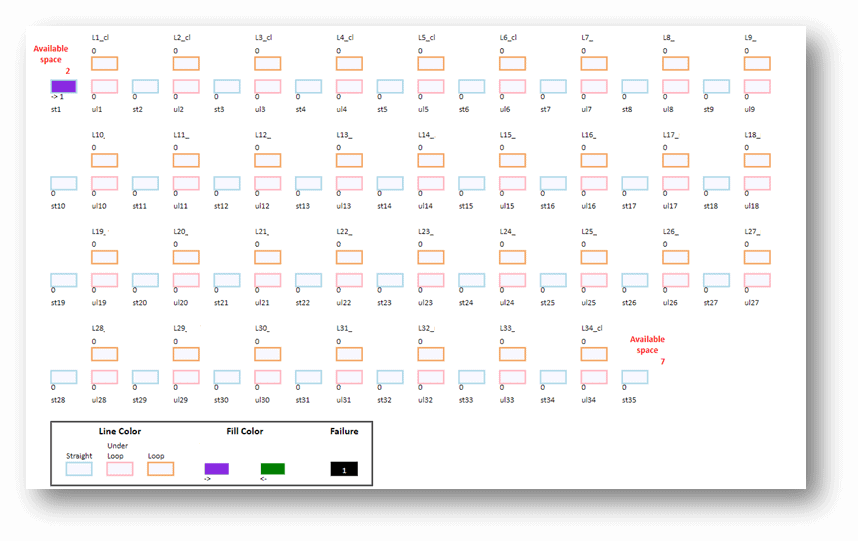
Since the rail is very long and difficult to visualize at appropriate scale during model run, we devised a visualization scheme for easily identifying train movement along the rail, essential for model validation.
Results
The simulation provided key insights into trade-offs between cycle time, congestion, and throughput.
Optimal Train Count
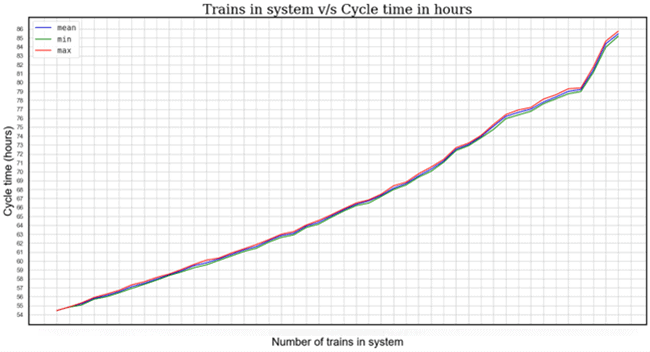
The system could support significantly higher numbers of trains per day without collisions. The mean cycle time increases as more trains are used, with a collapse at a certain threshold showing a rough increase in slope.
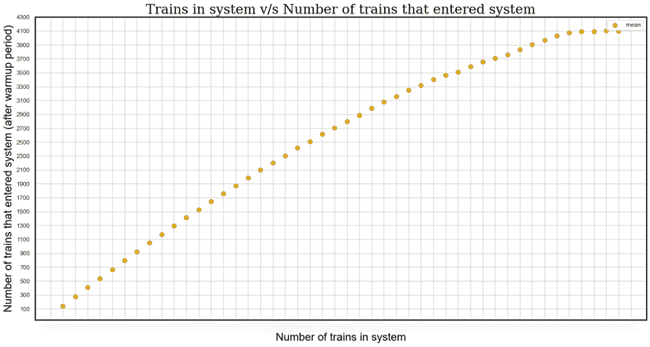
The total number of loaded trains that entered the system (throughput) during simulation shows the same trend — beyond a certain number, adding more trains is not worth it.
Bottleneck Identification
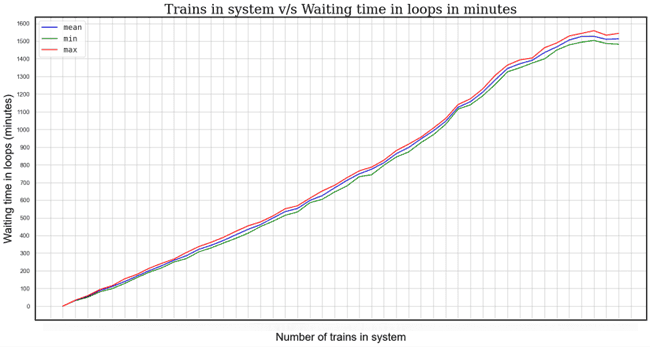
The primary limiting factor was the available space for unloading. At the threshold number of trains, the unloading side reaches its limit, indicating a bottleneck.
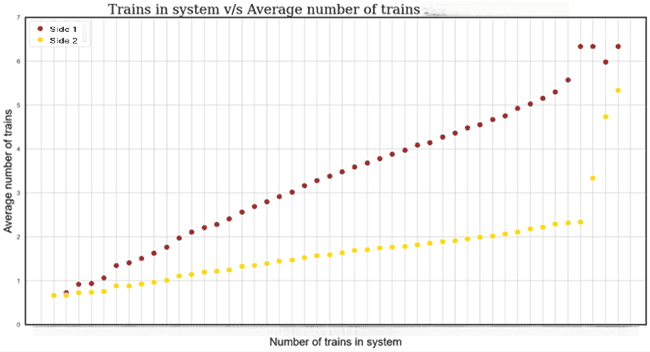
The railway operator gained valuable data-driven recommendations for improving infrastructure planning and throughput optimization.
Project Features
- Industry: Rail, Mining
- Model: Discrete Events
- Duration: 2 months
Need a similar simulation for your project?
Become a Client