Multi-Robot Navigation with Collision Detection
Challenge
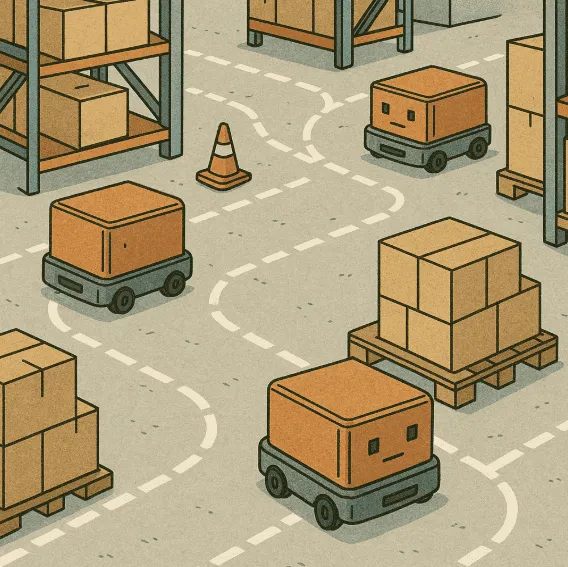
This project presents a flexible and dynamic simulation environment designed as a Digital Twin of a real-world multi-robot navigation system. Built using AnyLogic, the model allows real-time interaction with external clients and servers, supports dynamic configuration of maps and robot properties via JSON files, and simulates realistic behaviors such as obstacle detection, task execution, and robot coordination.
In systems involving multiple autonomous robots navigating shared environments, collisions can lead to significant operational disruptions. Clients require a testing platform to validate navigation and task assignment algorithms without the cost or risk of live experimentation.
Solution
Using AnyLogic as both a client and server, the simulation mimics real-time behavior of a robot fleet within a configurable map. Each robot is an agent acting as both a local server (receiving tasks) and a client (sending status updates) through Java HTTP servers.
Main Capabilities
- Fully dynamic map and robot configuration using JSON files, allowing testing on multiple maps without changing AnyLogic
- Real-time communication with external APIs to receive motion plans and return robot states
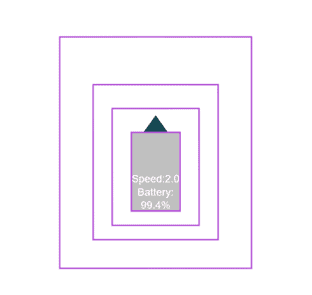
- Obstacle avoidance using Safety Zones and spatial quadrant logic
- Visual and logical representation of nodes, links, robots, and restricted areas
- Task execution validation through simulated collisions, obstacle detection, and battery tracking
Simulation Architecture
- Agent-Based paradigm: The map, robots, and static obstacles are modeled as agents
- Map generation: Dynamically built from JSON input describing nodes, links, obstacles, and special zones
- Robot profiles: Separate JSON file with dimensions, server port, battery level, speed, rotation speed, and configurable safety zones
Client-Server Interaction
- Robot as Server: Each robot opens a local server to receive task instructions from an external API
- Robot as Client: Each robot reports its position and battery level to the external decision-making server
Collision Handling
- Quadrant System: The environment is divided into spatial quadrants to reduce computational load — only adjacent quadrants are checked during movement
- Safety Zones: Multiple configurable zones extending from each robot body. If an obstacle enters a safety zone, the robot reduces speed. On body contact, the robot stops and flags the task as failed

Results
This simulation operates in real time and is used to:
- Visually verify robot behavior when given motion plans
- Identify potential collisions and evaluate plan viability
- Serve as a testbed for external algorithms, enabling debugging and risk-free iteration
Key Benefits
- Risk mitigation: Test behaviors in a safe virtual environment before deploying physical robots
- Flexibility: Fully customizable maps, robot types, and simulation rules
- Real-time feedback: Continuous communication with external systems enables dynamic testing
- Scalability: Adding more robots or obstacles only requires updating configuration files
Project Features
- Industry: Robotics
- Model: Agent-Based
- Duration: 3 months
Need a similar simulation for your project?
Become a Client