Traffic Intersection
Challenge
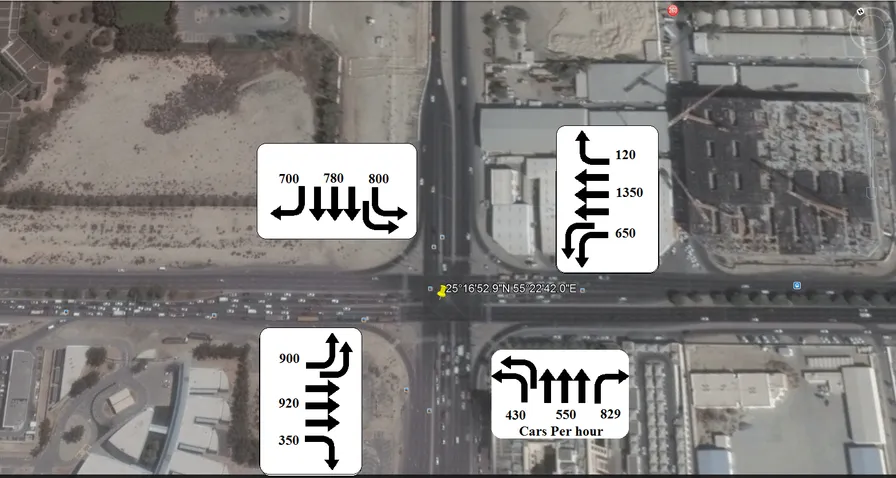
The objective of this simulation was to compare traffic flow and waiting times using optimized fixed traffic light timings against intelligent traffic lights using cameras to process the position and speed of the cars present in each side of the intersection. Each side of the intersection has five lanes: two allowing cars to turn left, and three allowing cars to go straight. These five lanes are controlled by traffic lights, with an independent lane with no traffic light that allows cars to turn right.
Solution
This model was implemented in AnyLogic using the road traffic library.
East Road Structure
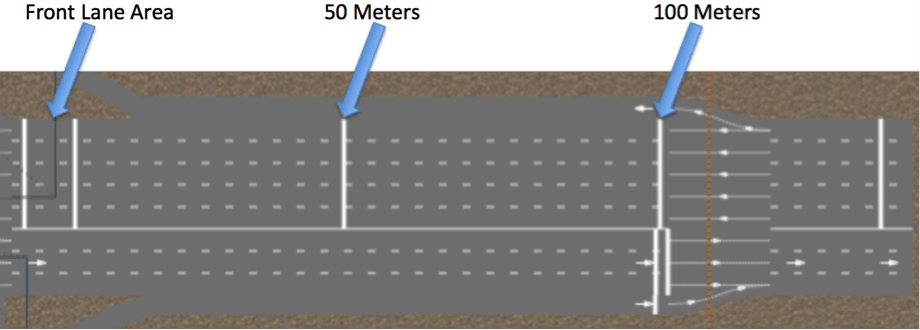
There are five lanes that go towards the intersection and one lane that allows cars to turn right. There are also three lanes that go away from the intersection coming from the west or from the north and an additional lane for cars coming from the south. Every side of the intersection works in the exact same way. Additionally, there is a front lane area which defines the cars that are in the first row when the light is red, a 50 meters line that defines how far the camera is able to see, and a 100 meters line used to analyze accumulation of cars.
Base Scenario
To accurately compare fixed traffic lights with intelligent traffic lights using cameras, it was important to optimize traffic light durations. An optimization experiment was performed in AnyLogic. The duration of the four green lights were defined as parameters to change with an objective function equal to the number of cars processed. The optimal durations after optimization with a total of 7,164 processed cars in an hour were:
- North: 15 seconds
- West: 10 seconds
- South: 16 seconds
- East: 16 seconds
CCTV Scenario -- Intelligent Algorithm
The challenge was to find an algorithm to improve traffic flow using cameras effectively. Several ideas were tested, such as:
- Using virtual loops to count how much time passes in each line between one car and another
- If there are no cars in the front lane area, the traffic light wouldn't turn green
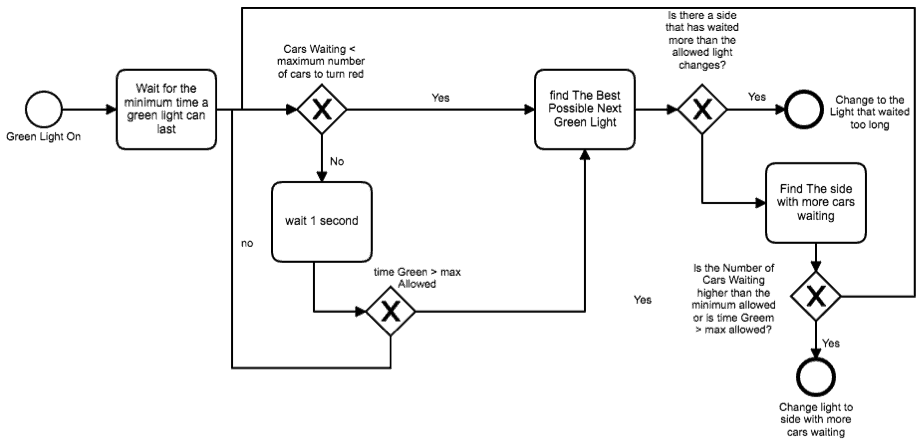
This algorithm has two parameters that need to be optimized: the maximum number of cars waiting after the 50-meter mark to turn the light from green to red, and the minimum number of cars waiting to turn the light from red to green. Through optimization, the best values were 13 and 17 seconds respectively.
Outcome
This study showed that in this intersection, with a high flow of cars and intense traffic, it is possible to use cameras with only 50 meters reach to improve not only the flow of cars but also to decrease waiting times. The algorithm used is very simple and uses basic information to make decisions. The improvement is only 1.7% of the traffic flow, so the economic implication of having this technology in place should be considered compared to the benefit.
Project Features
- Industry: Traffic
- Model: Discrete Events, Road Traffic Library
- Duration: 1 month
Need a similar simulation for your project?
Become a Client