UK Prison Population Growth

Challenge
The prison population of the UK has increased more than 400% in the last century and about 90% from 1990 to 2016. These numbers seem alarming and generate an incentive to spend resources to understand the projection in the next 20 years under a scenario where prisons are already overcrowded.
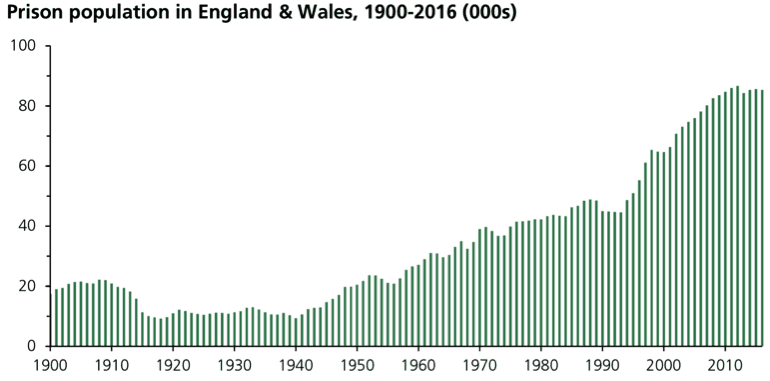
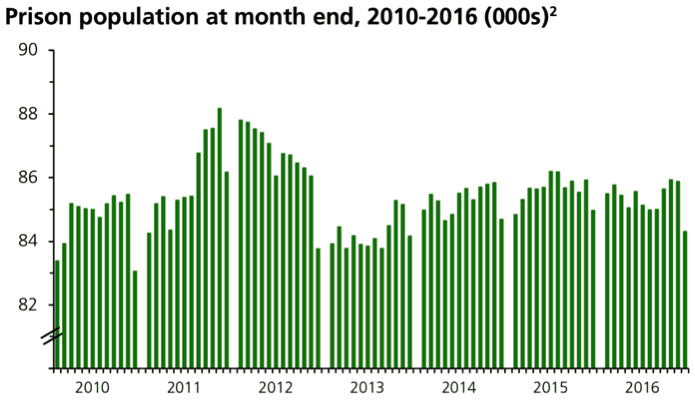
Nevertheless these numbers are perhaps misleading, considering that since the prison population reached its maximum in November 2011, it has since stagnated. So, has the UK reached a plateau? Will the population continue increasing with no control?
It is necessary to consider also that the number of crimes has decreased, which should from common sense lead to a decrease in the prison population in the long term.
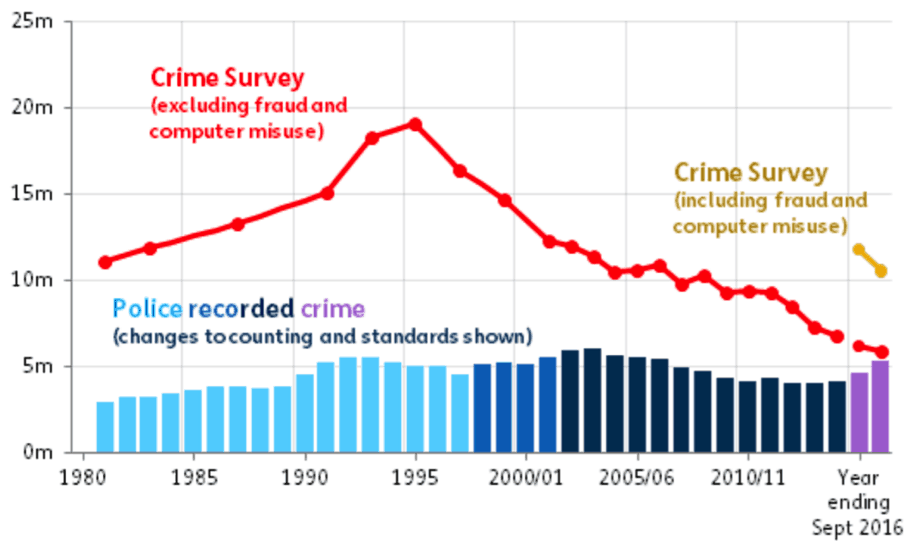
Prison population and crime are negatively correlated, and at worst if the crime has been constant, it will still have no effect on the population — so other policies have to be associated with the increase. The objective was to analyze this problem using public government data and estimate how the population in prisons will evolve in the next 10 years.
Solution
The simulation was built with a multi-model mind-set, being agnostic to any particular simulation paradigm: discrete-events, agent-based, and system dynamics.
System Dynamics Model
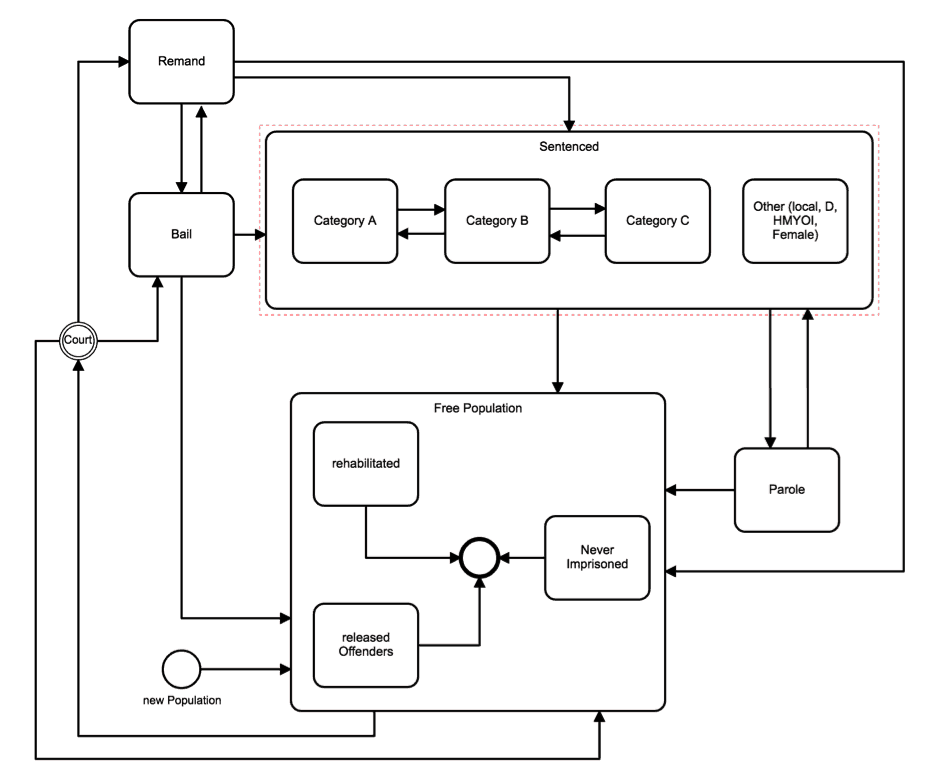
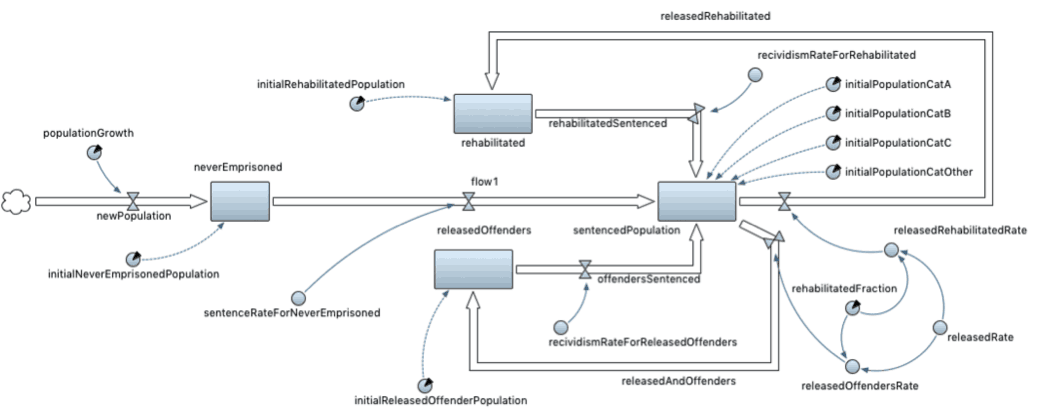
The System Dynamics model represents the abstract macro view of the system. It shows the high-level vision of the population dynamics, where new population arrives at an annual rate and is put in prison with a certain rate. This section stores the rehabilitated and released offenders for a general view on population evolution.
Discrete-Events Model
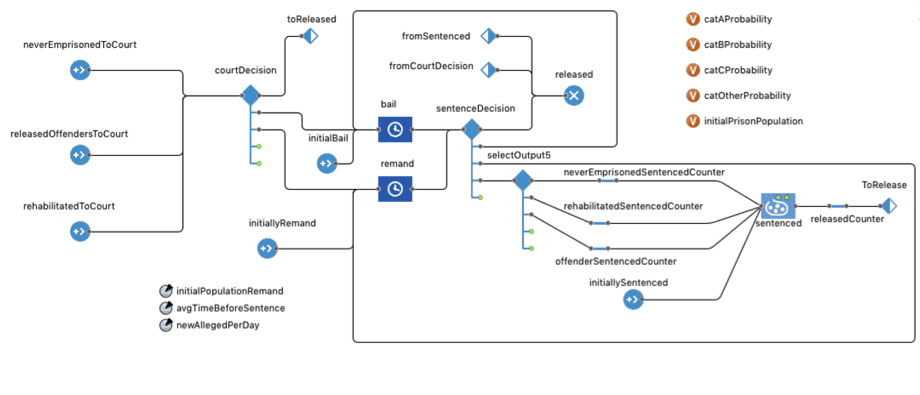
The Discrete-Events model represents the criminal justice process for people that do criminal actions and are put into court. New criminal cases come from 3 different sources: never imprisoned, rehabilitated, and released offenders. These individuals are put into court and can be either freed, put in bail, or put in remand, and later sentenced.
Agent-Based Model
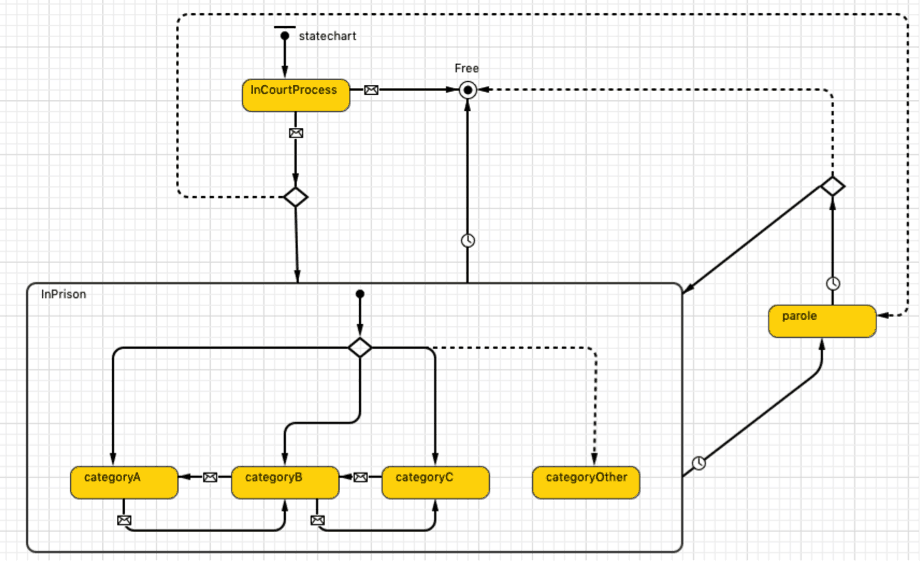
The Agent-Based section was generated to understand the main transitions from one state to the other for an individual potential prisoner, actual prisoner, or individual in parole.
Outcome
There is misleading information regarding how the prison population is evolving in the UK. Some sources hypothesize that the pressure of the media and the changes in sentences length are the key factors leading to a severe increase in the population and overcrowding. But policies always switch towards current tendencies. Overcrowded prisons can lead to a reduction in sentences and more people being released on parole.
The results show that overcrowding leads to putting more category A prisoners into category B facilities, which can decrease the safety perception from UK citizens. The simulation shows this problem but also that the problem stabilizes in the long run.
This study showed how the increase in prison population may not happen, which is consistent with statistical analyses showing that even though a small increase is projected, the confidence interval is quite wide and a decrease is perfectly plausible.
Project Features
- Industry: Government and Prisons
- Model: Discrete Events, System Dynamics, Agent-Based
- Duration: 1 month
Need a similar simulation for your project?
Become a Client