Production Facility Planning
Challenge
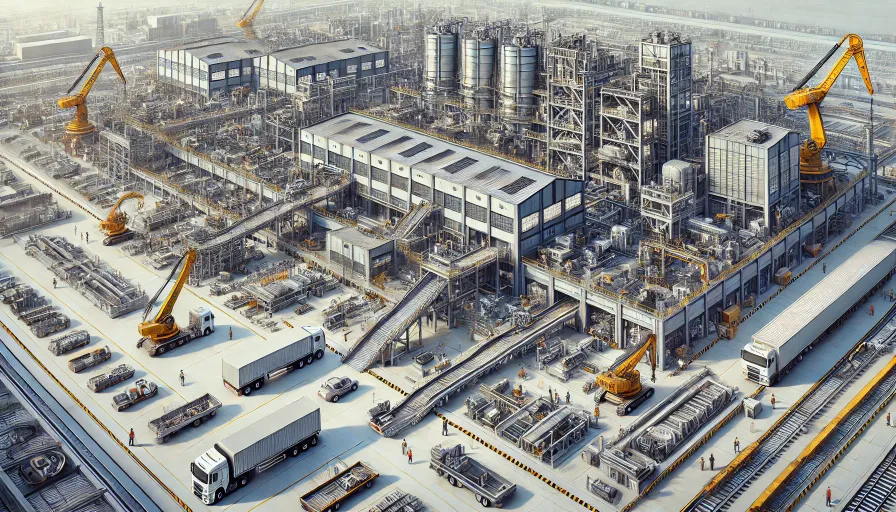
This project involved a production facility still in the planning phase and under construction. The focus was developing a digital twin to analyze production, logistics, and warehouse operations over a long-term planning horizon. The goal was to evaluate machine commissioning schedules, material flow, and production throughput while ensuring efficient intra-logistics and resource utilization.
A key challenge was determining the optimal timing for machinery deployment — whether earlier, later, or as originally planned — to balance capacity, demand, and operational efficiency.
Raw materials arrive and are stored in storage areas. Sales are estimated with around a 20-year look-ahead distributed monthly according to seasonality ratios. Several production lines are set to be commissioned at specific dates. Production is always done in lot sizes, with raw materials moved using specific transportation vehicles.
Solution
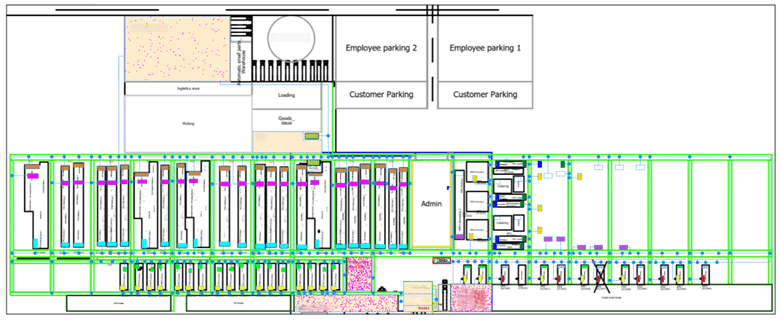
A simulation model was developed using AnyLogic's Process Modeling Library with a 2D layout representing the true facility layout.
Comprehensive Input Configuration
All information was configurable from an Excel sheet including:
- Estimated sales per year for each product type with seasonality ratios per month
- Production lot sizes for each product type
- Container capacity for each product type
- Machine commissioning dates and utilization percentage for breakdowns
- Raw materials composition for each product type
- Process production steps with cycle times at each step
- Setup times between different production types
- Transportation vehicle details (count, speed, loading/unloading durations)
Flexible Process Recipes
For greater flexibility, production steps were read from the Excel sheet and converted into a recipe in the model for each product type.
Data Export
Raw data exported from the model included:
- Vehicle movement information (initial location, destination, time, number of transported materials)
- Product processing steps (name, start and end times)
- Storage information (location, arrival and departure times)
- Production orders (order ID, waiting times for available production lines)
Results
By leveraging digital twin technology, the company gained a powerful tool for long-term strategic planning, specifically for:
- Production scheduling: Simulating the impact of different machine commissioning dates on output and efficiency
- Material flow analysis: Tracking inbound deliveries, storage requirements, and movement between processing stages
Project Features
- Industry: Manufacturing
- Model: Discrete Events
- Duration: 3 months
Need a similar simulation for your project?
Become a Client